
Nestled in the green hills of Cantabria near the medieval town of Santillana del Mar, the Cave of Altamira stands as one of humanity's most important archaeological sites. Discovered in 1868 by Modesto Cubillas and later studied by Marcelino Sanz de Sautuola, the cave contains polychrome paintings that have fascinated researchers and visitors for over a century. Today, the site is recognized as a UNESCO World Heritage Site and remains a cornerstone of our understanding of prehistoric culture.
History and Discovery
The story of Altamira begins in 1868 when a local hunter named Modesto Cubillas stumbled upon the cave entrance while pursuing a fox. It was not until 1879 that Marcelino Sanz de Sautuola, an amateur archaeologist from Santander, began systematic excavations. His eight-year-old daughter Maria famously pointed to the ceiling and exclaimed about the painted bulls, drawing attention to the remarkable artwork overhead.
The academic world initially rejected Sautuola's claims that the paintings were prehistoric. Critics, including leading French prehistorian Emile Cartailhac, accused him of forgery. It took over two decades and the discovery of similar paintings in other French caves before the scientific community formally acknowledged the authenticity of Altamira's art in 1902. Sadly, Sautuola had passed away in 1888 without seeing his discovery validated.
The cave's paintings are estimated to be between 14,000 and 36,000 years old, spanning from the Upper Magdalenian to the Gravettian period. Artists used natural minerals such as iron oxide for reds and manganese dioxide for blacks, applying pigments with their fingers, animal-hair brushes, and even rudimentary airbrush techniques.
What You Will See
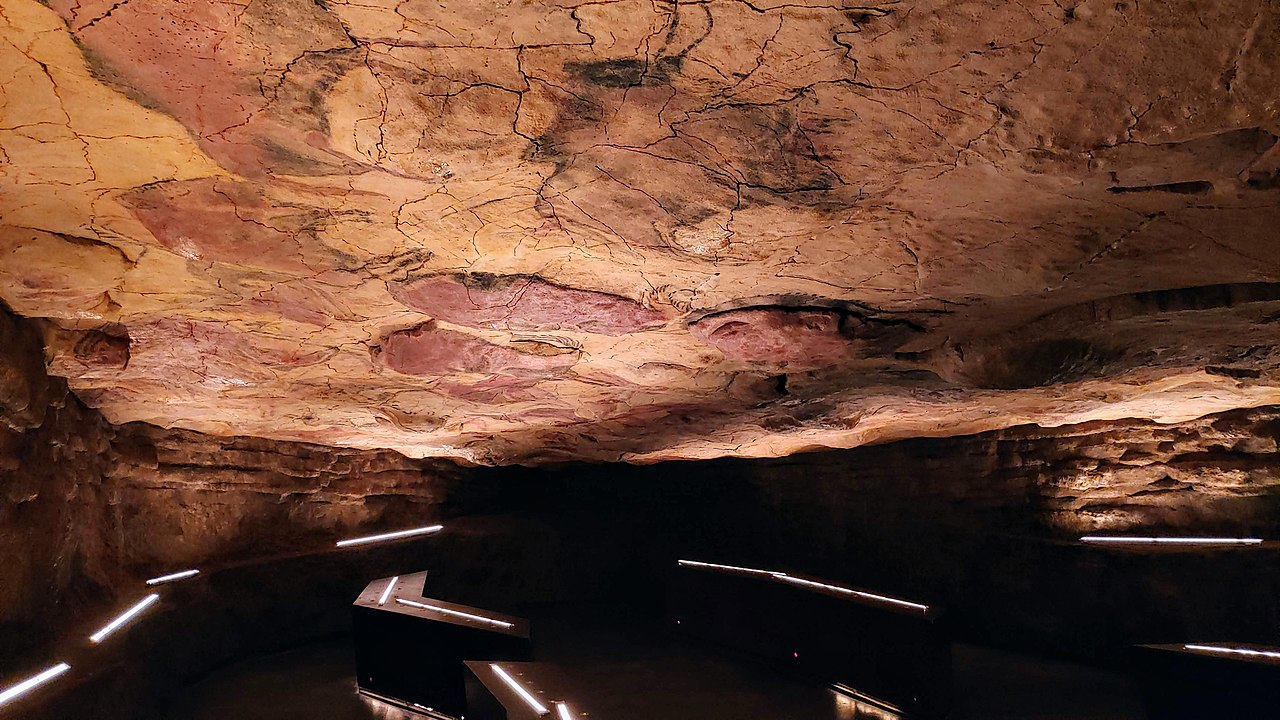
 Replica of the famous Altamira ceiling at the National Archaeological Museum, Madrid. Photo: Wikimedia Commons, Public Domain.
The main highlight is the Great Hall (Sala de Policromos), a chamber measuring roughly 18 meters long and 9 meters wide. The ceiling is covered with vivid paintings of bison, horses, deer, and hand stencils. The artists skillfully used the natural contours and bumps of the rock to give the animals a three-dimensional appearance, a technique that was revolutionary for its time.
Beyond the Great Hall, the cave extends for about 270 meters through several galleries. These contain engravings, black drawings, and various abstract signs whose meanings continue to be debated by researchers. The cave also contains evidence of habitation, including stone tools, animal bones, and charcoal remains.
The Neocueva Museum
Since the original cave was closed to the public in 2002 to prevent further deterioration from human presence (body heat, carbon dioxide, and moisture from visitors were damaging the paintings), the National Museum and Research Center of Altamira now offers visitors an extraordinary alternative. The Neocueva is a centimeter-perfect replica of the original cave, recreated using advanced photogrammetry and 3D scanning technology.
The museum also features interactive exhibits explaining Paleolithic life, a workshop where visitors can try painting with the same techniques used by prehistoric artists, and a comprehensive timeline of cave art discoveries worldwide.
Visitor Information
Location
Museo Nacional y Centro de Investigacion de Altamira, Avenida Marcelino Sanz de Sautuola, s/n, 39330 Santillana del Mar, Cantabria, Spain
Opening Hours
Tuesday to Saturday: 9:30 AM - 6:00 PM (May to October: until 8:00 PM). Sunday and holidays: 9:30 AM - 3:00 PM. Closed on Mondays.
Ticket Prices
General admission: 3 EUR. Free entry on Saturdays from 2:00 PM and all day Sunday. Children under 18 and seniors over 65 enter free.
Getting There
From Santander: 30 km west via the A-67 motorway, approximately 30 minutes by car. The nearest train station is Torrelavega (15 km). Buses run daily from Santander and Torrelavega to Santillana del Mar.
Tips for Your Visit
- Allocate at least 2-3 hours for the full museum experience, including the Neocueva and interactive exhibits
- The museum is fully accessible for visitors with reduced mobility
- Audio guides are available in English, Spanish, French, and German
- Photography without flash is permitted in most areas of the museum
- Combine your visit with a stroll through the charming medieval streets of Santillana del Mar, often called the "Town of Three Lies" (it is neither holy, nor flat, nor by the sea)
- The nearby village of Comillas and the seaside town of Suances are both worth a detour
Nearby Caves Worth Exploring
Cantabria is home to several other remarkable caves that can be combined with an Altamira visit. El Castillo and Las Monedas caves in Puente Viesgo feature their own impressive Paleolithic art and are open to the public. The Covalanas cave near Ramales de la Victoria contains rare red dot-outlined deer paintings. Together, these sites form part of the broader Paleolithic Cave Art of Northern Spain UNESCO designation.