

On the eastern coast of Mallorca, beneath the quiet fishing village of Porto Cristo, lies one of Europe's most remarkable natural wonders. The Caves of Drach (Coves del Drac in Catalan) are a network of four interconnected chambers stretching over 1,200 meters underground. Their highlight, Lake Martel, is one of the largest subterranean lakes on Earth, and the classical music concerts held on its glassy surface create an atmosphere unlike anything else in the Mediterranean.
A History Written in Stone
References to the Drach Caves date back to the Middle Ages. In 1338, an expedition ordered by the governor of Mallorca explored the entrance chambers, though the deeper sections remained unknown for centuries. The caves gained international attention when French geologist Edouard-Alfred Martel led a comprehensive exploration in 1896, funded by Archduke Ludwig Salvator of Austria.
Martel's expedition revealed the vast underground lake that now bears his name. He measured its dimensions at approximately 177 meters long and 40 meters wide, with a maximum depth of around 12 meters. The discovery transformed Porto Cristo into a destination for travelers from across Europe, and Jules Verne is said to have drawn inspiration from descriptions of the caves.
Since the 1930s, the caves have been open to the public with illuminated pathways and regular guided tours. The current route takes visitors through all four chambers: the Black Cave (Cueva Negra), the White Cave (Cueva Blanca), the Cave of Luis Salvador, and the Cave of the French (where Lake Martel lies).
What Makes These Caves Special
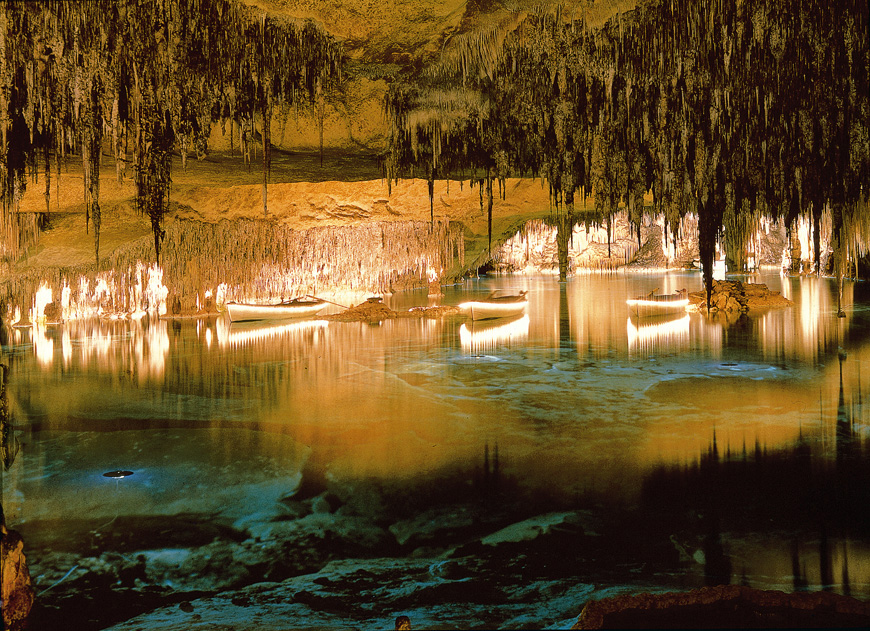 Lake Martel, one of the world's largest underground lakes, inside the Caves of Drach. Photo: Wikimedia Commons, Public Domain.
Lake Martel Concert
The undeniable highlight of every visit is the classical music performance on Lake Martel. After walking through approximately 1,200 meters of illuminated chambers, visitors arrive at a natural amphitheater overlooking the lake. The lights dim, and musicians on small illuminated boats glide across the water performing pieces by Chopin, Bach, and other classical composers.
The acoustics inside the cave are extraordinary. The limestone walls create a natural reverberation that envelops the music in a warm, resonant quality impossible to replicate in conventional concert halls. Performances last approximately 10 minutes, and afterward visitors have the option of crossing the lake by boat themselves.
Geological Formations
The caves descend to a maximum depth of 25 meters below the surface. Throughout the route, visitors encounter a stunning array of stalactites, stalagmites, columns, and flowstone formations that have developed over millions of years. The humid, mineral-rich environment means these formations continue to grow at a rate of approximately one centimeter per century.
Some of the most notable formations include the "Bathe of Diana" (a pool of translucent water surrounded by intricate flowstone), the "Flag" (a thin, almost transparent stalactite sheet), and several massive columns where stalactites and stalagmites have merged over millennia.
Visitor Information
Location
Ctra. Cuevas, s/n, 07680 Porto Cristo, Manacor, Mallorca, Balearic Islands, Spain
Opening Hours
Open daily year-round. Tours depart at fixed times: 10:00, 11:00, 12:00, 14:00, 15:00, 16:00, 17:00. Additional tours at 10:30, 11:30, 12:30 during peak season (April to October).
Ticket Prices
Adults: 16 EUR. Children (3-12 years): 10 EUR. Children under 3: free. Group discounts available for parties of 20 or more. Online booking recommended.
Getting There
From Palma de Mallorca: approximately 60 km east via the Ma-15 motorway, about 1 hour by car. Regular bus service (line 412) runs from Palma to Porto Cristo. The town is also accessible by boat from several coastal resorts.
Practical Tips
- Arrive at least 20 minutes before your tour time as late arrivals may not be admitted
- The walk through the caves covers approximately 1.2 kilometers and takes about 50-60 minutes including the concert
- Temperature inside is a constant 17-21 degrees Celsius with high humidity, so bring a light layer
- The path includes stairs and some uneven surfaces; the caves are not fully wheelchair accessible
- Photography without flash is permitted throughout the visit
- Combine your visit with lunch in Porto Cristo, which has excellent seafood restaurants along the harbor
- The nearby Caves of Hams are just 1 km away and offer a complementary cave experience with fewer crowds
Best Time to Visit
While the caves are open year-round, the best experience depends on your preferences. Summer (June through August) offers the most tour times but also the largest crowds, with wait times of up to an hour possible. Spring (March to May) and autumn (September to November) provide a pleasant balance of good weather and manageable visitor numbers. Winter visits are the quietest, though some early morning tours may be reduced.
Regardless of when you visit, the caves themselves maintain their timeless beauty. The constant temperature and humidity mean the formations look identical whether you visit in January or July.